
A Red River Gorge cabin investment is rarely won or lost on the nightly rate shown in an online search. It is won in the less glamorous details: whether guests can reach the property after a hard rain, whether the septic system matches the sleeping capacity being marketed, whether insurance is available at a workable premium, and whether the gross revenue estimate still makes sense after management, maintenance, utilities, and reserves.
The Gorge has genuine demand. Climbers, hikers, wedding guests, families, and Lexington-area buyers seeking a quick reset continue to support a distinctive lodging market. But it is not a uniform market, and a cabin with a pretty view is not automatically a sound investment. The better question is whether a specific property can operate reliably, legally, and profitably in its exact location.
What Makes a Red River Gorge Cabin Investment Different
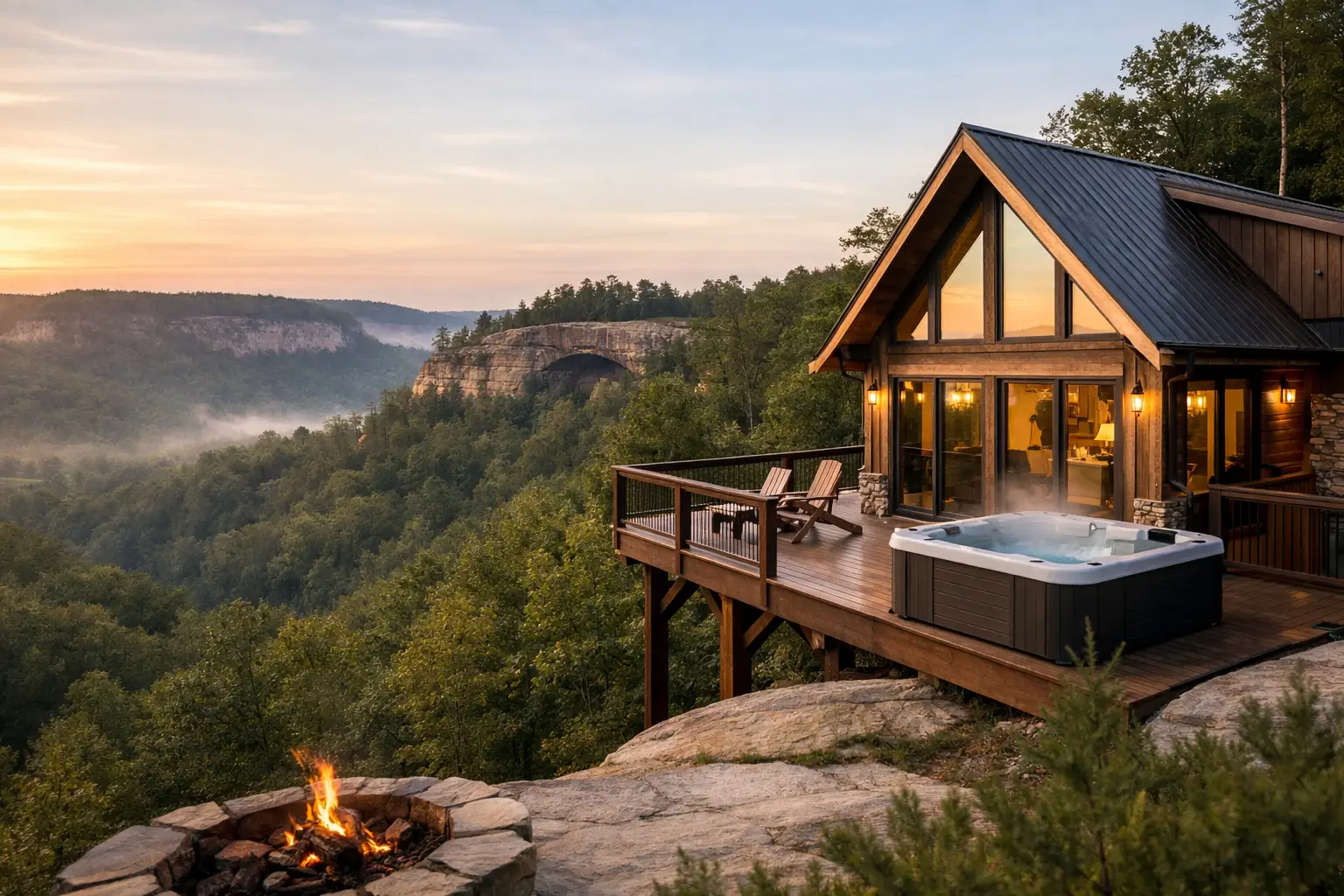
Red River Gorge cabins trade on experience. Guests may pay a premium for a hot tub, fire pit, wooded privacy, architectural character, pet-friendly policies, proximity to trailheads, or a view that feels removed from ordinary life. A well-positioned cabin near Slade can attract a different guest than a larger, more secluded property farther into Wolfe, Powell, Lee, Menifee, or Estill County.
That distinction matters because location affects more than demand. It changes drive times, road maintenance, cellular service, emergency access, trash service, utility reliability, and the practical cost of turning a rental between stays. A property can be technically close to the Gorge yet feel inconvenient to the guest who arrives after dark on an unfamiliar two-lane road.
Unlike a conventional long-term rental, this asset is an operating business tied to a real property. The buyer is underwriting land, improvements, furnishings, local regulations, guest expectations, and an ongoing maintenance program at the same time. Gross bookings are only one input.
Start With Revenue, Then Stress-Test It
A credible income estimate should begin with comparable cabins, not broad regional averages. Compare bedroom count, guest capacity, finish level, amenities, road access, proximity to Slade and major recreation draws, and whether the property has meaningful differentiation. A three-bedroom cabin with a hot tub and polished interiors may compete in a different rate band than a basic three-bedroom on the same road.
Past booking statements can be useful, but they are not proof of future performance. Ask how the revenue was generated. Was the owner actively managing pricing? Did the property benefit from unusually strong reviews, a recent renovation, or a one-time event cycle? Were owner stays blocked during high-demand weekends? Did the reported figure include cleaning fees or taxes that do not belong in operating revenue?
A conservative underwriting model should separate gross rental revenue from the money actually available to the owner. Account for management fees, platform fees, cleaning coordination, laundry, consumables, electric, internet, propane, water, septic service, pest control, snow or road work where applicable, repairs, furnishings, insurance, property taxes, and a capital reserve.
Cabins are hard on systems. Hot tubs need regular attention. HVAC equipment works through Kentucky humidity and winter cold. Decks, stairs, roofs, retaining walls, and gravel drives all require recurring capital. An owner who models only mortgage payment, taxes, and a cleaning fee is not modeling the asset.
Seasonality Is a Planning Issue, Not a Footnote
The Gorge has multiple demand drivers, which is an advantage. Climbing and hiking seasons can be strong, weekends carry disproportionate weight, and fall can produce exceptional demand. Still, weekday occupancy and shoulder-season performance often decide whether an investment has sufficient margin.
Build a monthly model rather than applying one annual occupancy percentage. Then test it against a lower-rate, lower-occupancy case. If the property only works at an optimistic average daily rate and near-perfect weekend conversion, the acquisition price may be too aggressive or the operating plan too thin.
Sewer First, Always: Utilities and Site Due Diligence
For rural Kentucky cabins, sewer first, always. Many properties rely on septic systems, and the distinction between bedroom count, septic capacity, and advertised guest count can be consequential. A listing may describe bunks, lofts, or sleeping rooms that do not align with the system’s permitted design. That creates operational, regulatory, and resale risk.
Obtain the available septic records, identify the system type and location, and understand its service history. Ask where replacement area may exist if the current system fails. An inspection should go beyond a casual look at the yard. Buyers should also verify the water source, water pressure, filtration needs, well records if applicable, and any shared-water or private-road agreements.
Roads deserve the same seriousness. Who owns and maintains the approach? Is there a recorded easement? Can a standard guest vehicle reach the cabin in wet weather? Will a propane truck, trash hauler, cleaner, emergency vehicle, or repair contractor have practical access? A steep, narrow drive can be part of the cabin experience, but it may also narrow the guest pool and raise operating costs.
The property condition review should include roof age, drainage, foundation movement, deck structure, retaining walls, tree risk, moisture control, HVAC, electrical capacity, internet options, and cell coverage. In a remote setting, a small deferred-maintenance issue can become expensive because service calls take longer and contractor availability can be limited.
Regulations, Restrictions, and the Cost of Being Wrong
Short-term rental rules are local and can change. County requirements, building-code considerations, occupancy standards, lodging taxes, business licensing, deed restrictions, homeowners association rules, and insurance requirements should be verified for the specific parcel before a buyer removes contingencies. Do not rely on a seller’s statement that a cabin has “always been rented.” Prior use is not a complete legal or operational analysis.
If the property sits in a development, read every recorded restriction and amendment. Some communities regulate rental duration, parking, signage, noise, exterior changes, or amenity use. Others place maintenance obligations on owners that affect annual expenses. The same is true for private roads and shared drives: the agreement may be more important than the view.
Insurance deserves early attention. Wood construction, remote fire response, steep drives, water features, hot tubs, and rental use can affect availability, deductibles, exclusions, and premiums. Request quotes before finalizing the financial model, not after inspection. A low initial insurance estimate can make an otherwise marginal deal appear viable.
Buy the Right Cabin, Not the Loudest Listing
The strongest investment candidates generally have a clear guest proposition and fewer hidden operating problems. That does not always mean the newest or largest cabin. A modest property with excellent access, reliable systems, a well-designed outdoor area, and a manageable maintenance profile may outperform a more dramatic cabin that is difficult to reach and expensive to keep guest-ready.
Consider who the intended guest is. A two-person retreat can command a healthy rate with privacy, design, and a quality hot tub. A family-oriented cabin may need usable bedrooms, safe outdoor space, durable furnishings, and dependable internet. A group property requires adequate parking, septic capacity, noise management, and enough common space that the sleeping count feels credible rather than crowded.
This is also where buyer goals matter. Some owners want personal use and will accept lower yield in exchange for protected weekends. Others need income consistency, a 1031 exchange replacement property, or a business that can support professional management. Neither approach is wrong, but the underwriting should match the purpose. A personal retreat should not be priced as though every premium weekend will remain available for rental.
An Exit Strategy Should Be Present at Purchase
Cabin values can be influenced by lifestyle demand, construction quality, acreage, views, road conditions, and income history. But short-term rental revenue is not guaranteed to transfer neatly to the next owner. A buyer should be able to explain the property’s appeal without relying entirely on one year of bookings.
Think through the likely resale audience. Is the next buyer an investor, a second-home owner, a local household, or someone seeking land and privacy? A cabin with broad appeal, documented improvements, clean records, and well-maintained systems is easier to position when market conditions change. Keep invoices, permits, septic records, service logs, and before-and-after documentation. In a rural transaction, orderly records can materially improve buyer confidence.
A disciplined Red River Gorge cabin purchase is not about finding a fantasy number on a revenue calculator. It is about paying the right price for a property whose access, systems, regulations, guest appeal, and operating costs have been examined in writing. The cabin should still make sense after the view wears off and the first repair invoice arrives.
Leave a Reply