


Living in Lexington, Kentucky: The Full Guide
Living in Lexington, KY means a city that decided, decades ago, where it would stop — and became more livable for it.
Lexington is a mid-sized city ringed by protected horse farms, anchored by the University of Kentucky and a large healthcare economy. Its Urban Service Boundary keeps the city compact, so neighborhoods range from walkable historic streets near downtown to newer suburbs along Man o’ War Boulevard. Daily life runs on a university-and-racing calendar, commutes stay short by big-city standards, and the trade-off is a tighter housing supply than sprawling metros. Assessment and ownership records for any Lexington address are public through the Fayette County PVA.
The Shape of the City
Lexington made an unusual decision in 1958: it drew an Urban Service Boundary — among the first in the nation — and kept the horse farms outside it. The result is a city you can cross in under half an hour, with working farmland beginning where the last subdivision ends. That boundary explains almost everything about living here: short commutes, a compact downtown, neighborhoods that hold their identity, and a housing supply that runs tighter than in metros that grow outward without limit.
A city that decided, decades ago, where it would stop — and became more livable for it.
Neighborhoods by Era
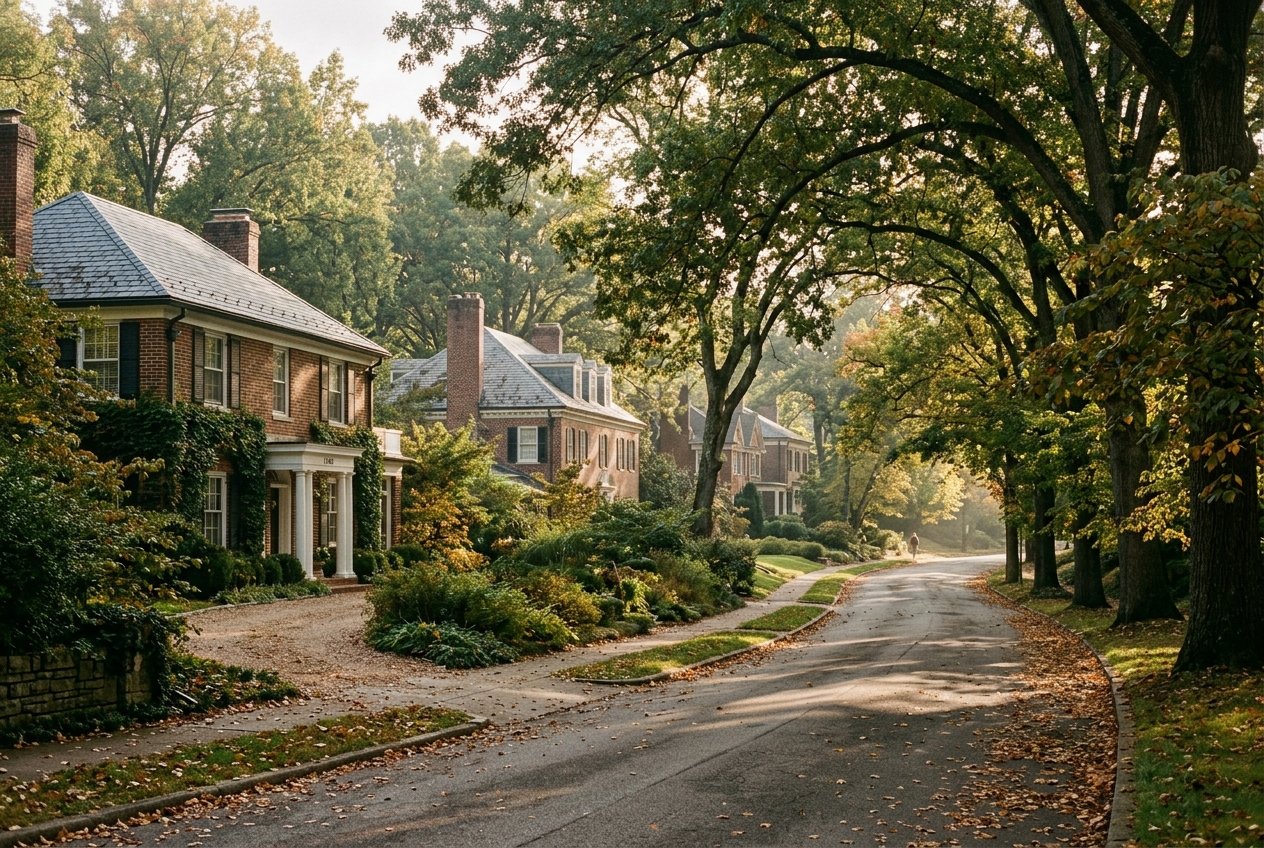
The housing stock reads like tree rings. Closest to downtown sit the historic districts — Chevy Chase and Ashland Park among them — with early-twentieth-century architecture and sidewalk-first street grids. A mid-century ring of ranches and split-levels follows inside New Circle Road. Beyond it, the late-century and current suburbs: Beaumont on the southwest side and Hamburg on the east, both built around retail and parkway access. Each era carries its own maintenance profile and price logic — worth understanding before you tour.
The University and Healthcare Economy
The University of Kentucky is the city’s gravitational center — its campus, athletics, and UK HealthCare medical complex together form one of the state’s largest employment anchors, joined by Baptist Health and CHI Saint Joseph elsewhere in the city. That base gives Lexington an economic steadiness and a constant flow of arriving residents. If a hospital start date is driving your move, the UK HealthCare relocation guide covers that path in detail.
Getting Around
Two ring roads organize the map: New Circle Road around the older city, Man o’ War Boulevard around the newer edge, with spoke roads — Nicholasville, Richmond, Versailles, Harrodsburg — radiating between them. Most crosstown drives run twenty to thirty minutes. Downtown, Chevy Chase, and a handful of older districts offer genuinely walkable daily life; most of the newer city assumes a car. Blue Grass Airport sits beside Keeneland on the west side, close enough that frequent flyers factor it into neighborhood choice.
Seasons and the Calendar
Lexington keeps four real seasons and a civic calendar to match: Keeneland’s race meets in April and October, UK basketball carrying the winter, spring thick with dogwood and redbud, and summer evenings built for porches. Winters bring occasional ice and snow rather than long freezes. The rhythm matters to buyers more than they expect — race weeks and home-game Saturdays genuinely move traffic and restaurant reservations, and most residents learn the calendar within their first year.
The Honest Ledger
What you gain: short commutes, a landscape of stone fences and farmland minutes from any doorstep, university-city culture, and a compact scale that makes the whole city usable. What you accept: a constrained housing supply that keeps competition real inside the boundary, property taxes and prices above the surrounding counties, and summer humidity that earns its reputation. Buyers wanting more land for the dollar often look at the ring towns — the communities hub maps those alternatives honestly.
Common Questions
Do I need a car to live in Lexington?
In a few older districts — downtown, Chevy Chase, the university edge — daily life works largely on foot, and Lextran buses cover major corridors. Most of the city, though, is built at suburban scale, and nearly all households run at least one car. Choose the neighborhood first; the transportation answer follows from it.
Is Lexington affordable compared to other cities?
Against the largest metros, Lexington generally reads as reasonable; against its own surrounding counties, it carries a premium tied to the Urban Service Boundary and demand. Current figures shift with the market — ask me for dated numbers or see the market report rather than trusting a static page.
Which part of Lexington should I look at first?
Match era to taste: historic streets near downtown for character and walkability, the mid-century ring for lot size and value, Hamburg or Beaumont for newer construction and retail convenience. A one-day tour across all three rings tells most buyers which Lexington is theirs.
Start with the Lexington overview, then go deeper into Chevy Chase & Ashland Park or the relocation guide.
Marcos Gil, REALTOR® · Keller Williams Commonwealth · Based in Beattyville, serving Lexington to the Red River Gorge · Also owner of Central Property Services and publisher of Invest in the Gorge — any recommendation involving my other businesses is disclosed in writing.
Plan Your Lexington Move
Last updated: August 19, 2026